A Stylistic Lineage Tree
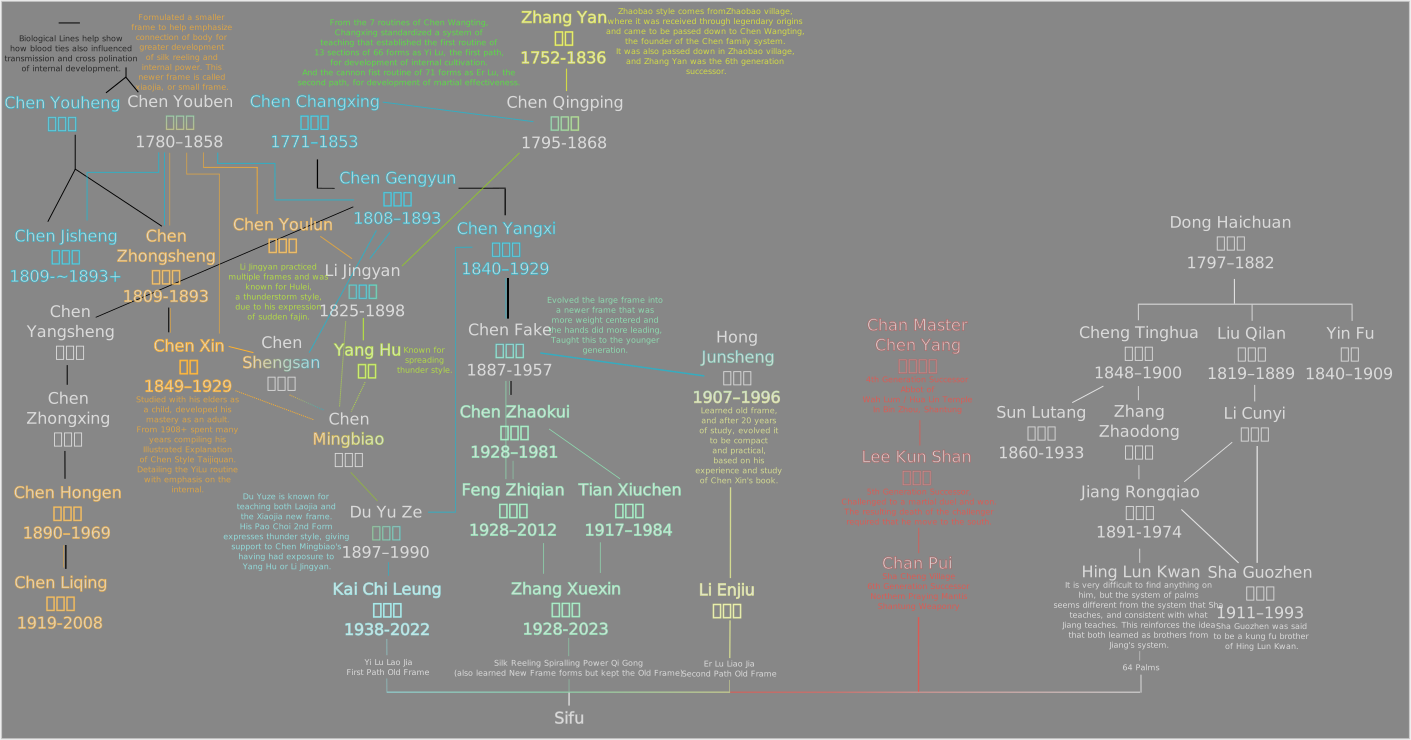
Here (opens in a new tab) is Kai Chi Leung's commemoration, which includes the connection to his Chen lineage via Du Yuze.
A Note On Frame Names
Before Chen Fake and Chen Zhaopi left Chen Village for Beijing, there were two frames - daijia (big frame) and xiaojia (small frame). Small Frame is mostly associated with Chen Xin, while Big Frame was good for learning / training with, and was what these masters brought with them to Beijing.
During their time in Beijing, both Chen masters evolved their forms. Meanwhile there were hardships back in the village and the art faded. When Chen Zhaopi retired, he returned to the village and taught again, working hard to bring back the skill of Chen Village. He taught the Four Tigers, which included Chen Xiaowang.
Meanwhile Chen Fake had been teaching Hong Junsheng, Feng Zhiqiang, and his son Chen Zhaokui. By the time Chen Fake was older, Hong revisited him to train more, and noticed that the frame had evolved, as had Hong's own frame during his time training alone. Hong went on to share the Practical Method, and Feng Zhiqiang emphasized the spiraling power of his Hunyuan Qigong system. Chen Zhaokui had studied with his father and with Feng, who was like an older brother.
So when Chen Zhaokui came back to teach in Chen Village, the dajia form he brought with him now differed from what had been taught by Chen Zhaopi. So the Villagers began calling Zhaopi's frame laojia (old frame) and Zhaukui's xinjia (new frame). This terminology was not necessarily accurate as it made one seem newer than the other, but truly both frames had evolved from the older dajia frame. Chen Zhaokui did not like the distinction and it was not used in the family. Chen Yu, his son has said it can make things less political if people refer to the forms by the number of movements, but this has not become mainstream. Chen Yu now refers to the family frame as 'jiachuan gongfu' - the gongfu frame that has been passed down in the family.
And while all of this was going on, Du Yuze had been in Taiwan was teaching the dajia frame he had learned from Chen Fake's father, Chen Yanxi. This was passed to Kay Chi Leung in Taiwan, who later moved to Boston, where he taught it to Frank Paolillo. So this frame may exhibit some of the larger movements and longer stances than the frames that evolved during Chen Zhaopi and Chen Fake's time in Beijing.
Du Yuze also learned a different frame from Chen Mingbiao, referred to as xinjia / new frame. Back before the Beijing frames, there was just big frame and small frame. But small frame was newer so it was called new frame for a while then. Presumably Chen Mingbiao taught a flavor of small frame, but notably it also contained elements of the hulei thunder frame from neighboring Zhaobao Village. Where rumor has it an old sage originally taught the earliest version of these forms. Du Yuze was known to teach both frames separately and according to how he was taught them.
There seems to be some conflicting information about Du Yuze's teacher Chen Mingbiao and what style he taught. Here is an article about Du, and here a commemoration. From that, it seems to suggest that he learned an old frame and a new frame system.
Chen YanXi would have been the source of the old frame.
And Chen MingBiao the source of the new frame, which seems to have been a blend of small frame with some Zhaobao thunder (Hulei) flavor. The small frame was the original 'new frame' and Cheng MingBiao's was a little more unique. But both are different from Chen Fake's 'new frame', which most people mean when they say 'new frame' today.
Here (opens in a new tab) is a video of Du Yuze performing Chen YiLu (First Path). This would appear to be his transmission of Chen YanXi's old frame.
Here (opens in a new tab) is that same form, where again it is listed as the old frame. In the comments someone says it is a modified version of Chen Xin's XiaoJia, Small Frame. However, that seems unlikely.
Perhaps this is due to how the old frame generally seems to have many different presentations. And how it can perhaps be seen that Du Yu Ze is utilizing small frame coiling power within the old frame.
Here (opens in a new tab) is that same video, on youtube, titled:
杜毓澤陳氏太極拳老架
Du Yuze, Chen Style Tai Chi Old Frame
For comparison, here (opens in a new tab) is Wang Chang Jiang performing the old frame form. His grandfather Wang Yan was apparently (opens in a new tab) taught together by Chen YanXi and Chen Fake, and ensured the teaching of Chen YanXi's transmission after Chen Fake left for Beijing.
This old frame form bears remarkable similarity to Du Yu Ze's old frame form, revealing the link to Chen YanXi.
This (opens in a new tab) page discussing the overall flavorful history of Taji lineages may also be helpful.